
Building to last

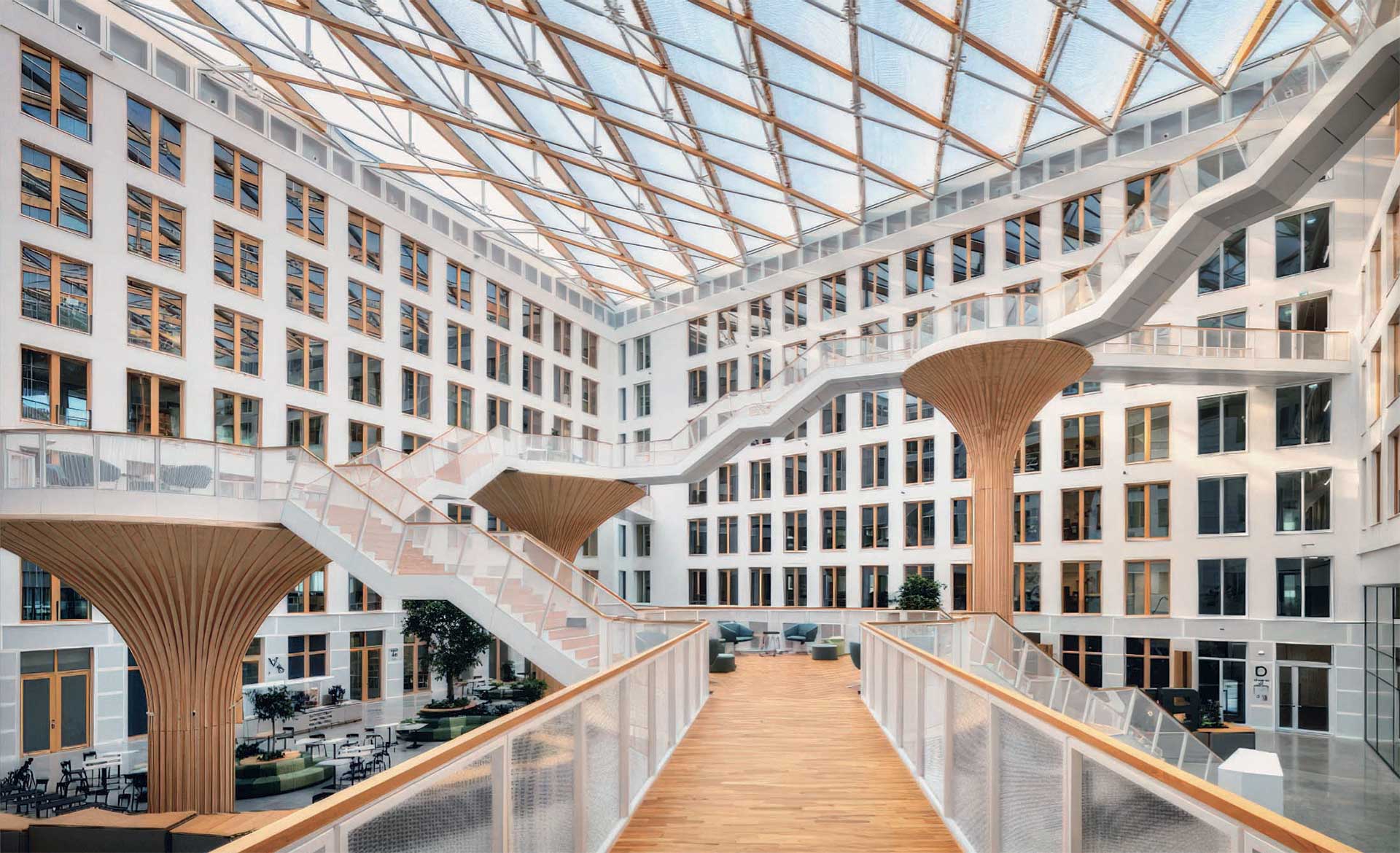
The Valle d’Aosta University (Italy) was created from the conversion of the former Testafochi barracks complex and is an example of the successful transformation of a heritage building into a contemporary university campus. The site was redeveloped in 2024 to accommodate efficient teaching spaces adapted to current uses.
 ›
Circularity
›
Building to last
›
Circularity
›
Building to last 
 3 min
3 min
Share

Écouter cet article
La version audio est fournie par Trinity Audio. Son activation dépose des cookies permettant de vous identifier de manière persistante. En savoir plus
As pressure on resources intensifies, the construction sector is rethinking its practices to better address resilience and adaptation, extend the performance of materials, design spaces that can evolve over time, and make better use of existing materials. These are all key levers for ensuring the long-term durability of buildings. Examples.

Withstanding climate shocks without overconsumption
The resilience and adaptation approach to climate hazards makes it possible to design buildings that can absorb shocks, remain operational in the event of a disaster, and suffer minimal damage. Every disaster prevented and every instance of damage contained avoids costly repairs that consume resources and emit carbon, while extending the life of the building and reducing pressure on raw materials.
Watch also: Episode 3: adaptation? Resilience? When our buildings learn to live with the climate
Enhancing material performance over the long term
Better formulated materials that are less sensitive to temperature variations, humidity, or mechanical stress reduce the need for frequent maintenance and replacement. Construction chemicals have a central role to play: extending service life, maintaining thermal and mechanical properties, and preventing premature deterioration. Extending the life of materials means reducing the extraction, processing, and transportation of virgin resources.
Read also: Durable materials: 3 innovations that extend infrastructure lifespan
Long-lasting but adaptable
A building designed for a single purpose is a fragile building. Needs evolve in step with social, economic, and demographic changes. Building to last means anticipating change. Reversibility of spaces, structures capable of accommodating new programs, adaptable technical systems: the ability to evolve is becoming a major criterion for durability. Transforming a building rather than demolishing it saves a considerable amount in materials and energy, while extending the building’s useful life.
Read also: Reversible and modular constructions: are they models of circularity?
Circularity and traceability: conserving existing material
In a world where some essential resources are becoming scarce, every building must be designed as a reservoir of materials ready to be reused. Preserving existing buildings, recovering components, recycling materials: circularity is becoming an essential lever when building to last. It requires better traceability of building components in order to determine their origin, performance, and potential for reuse. Conserving resources is not just about reducing future consumption. It is also about making the most of what is already there, rather than systematically starting from scratch.
Read also: Avoid waste! Yes, but how?