

 ›
Quality of living
›
Silence! Make way for well-being.
›
Quality of living
›
Silence! Make way for well-being. 
 8 min
8 min
Share

The figures are staggering. In Asia, the Bangladesh capital Dhaka has recorded road traffic noise levels reaching 119 decibels, Moradabad in India 114 dB, and Islamabad in Pakistan 105 dB. In Africa, Ibadan in Nigeria and Algiers in Algeria both exceed 100 dB. Western cities are not far behind: Paris reaches 89 dB, London 86 dB, New York 95 dB. All these figures are far higher than the 53 dB recommended by the WHO for road traffic.
And noise is a cause of discomfort: in Europe, 22 million people suffer from chronic noise-related discomfort, and 6.5 million experience sleep disorders. In offices, 63% of workers do not have a space that is quiet enough to concentrate, and performance can drop by up to 66% in the presence of noise pollution.
Faced with this urban cacophony, the search for greater acoustic comfort has become a necessity, prompting architects, acoustic technicians and manufacturers to design spaces where noise no longer dictates the rules.
Thinking silence right from the design stage
Acoustic comfort is improved when it is considered in the very first sketches. Generative design and digital modeling are among the tools that facilitate this approach, with the future acoustics included in every design decision, avoiding costly corrections during construction or operation.
For offices and homes alike, acoustic simulation software evaluates sound performance right from the design stage. Tools have been developed to simulate sound propagation and estimate predicted compliance with acoustic requirements, such as AcouBAT, developed in France by CYPE and the CSTB (Scientific and Technical Center for Building) for new or renovated buildings, CadnaR from the US company acoem for tertiary buildings, or the Swedish CATT-Acoustic for modeling complex rooms. These simulators allow different design options to be compared: positioning of partitions, choice of suitable acoustic solutions, or configuration of indoor spaces.
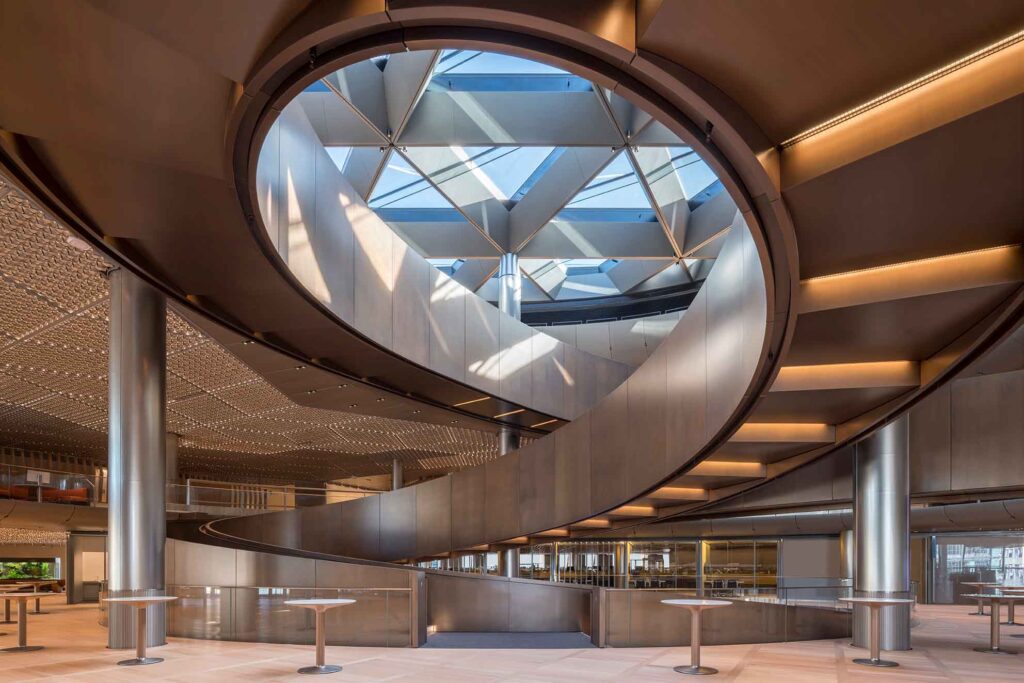
For Bloomberg’s European headquarters in London, acoustics technicians made extensive use of auralization (sound simulations that allow the acoustics of a building to be heard before it is built) to test different workstation configurations and assess the impact of urban noise through the naturally ventilated façade. The result is an integrated ceiling with a unique “petal” geometry that provides both sound absorption and diffusion, improving acoustic privacy in open-plan offices.
Making existing buildings quieter
While designing for silence from the outset is ideal, the reality is that many existing buildings are in need of acoustic renovation, presenting a major challenge. In northern countries, most of the existing building stock dates from a time when acoustic standards were less stringent: more than 70% of European buildings date from before 1990, and 60% of North American buildings from before 1980. These millions of square meters require acoustic upgrades to meet contemporary comfort standards.
Such upgrades radically transform the user experience.
The stakes are particularly high in the healthcare sector, as acoustic comfort can sometimes contribute to the healing process. Many hospitals are making it one of their design or renovation priorities. The IASI Polyclinic in Romania is a good example. Opened in 1980, it underwent a complete renovation completed in December 2024. The work focused in particular on ceilings and insulation systems, with the aim of creating optimal conditions for patient care and rest, as well as comfortable working conditions for healthcare staff. The reverberation time, reduced to 0.8 seconds, ensures that conversations remain intelligible without spreading, thus preserving the privacy of consultations and medical confidentiality between rooms.
In the hotel sector, acoustic comfort also directly contributes to the quality of the customer experience. The Bulgari Hotel Roma, which opened in 2023 in a 1930s building in the heart of Rome, exemplifies this requirement. The renovation of its 114 rooms included high-performance acoustic glazing and insulating partitions adapted to each constraint of the historic building. This project demonstrates that successful acoustics is not limited to installing sound-absorbing panels: it requires rethinking the use of space so that acoustic comfort becomes a core element of the architecture.
New generation materials
While forward-thinking design and smart renovation play a key role, acoustic comfort can also be improved through recent advances in materials. A new generation of insulation materials now combines acoustic performance with sustainability.
This trend is particularly evident with mineral insulation materials. While glass wool has long been known for its excellent acoustic performance, manufacturers are now working to improve its environmental impact and installation conditions. Lanaé, developed by Isover, reflects this trend: a bio-sourced binder replaces the traditional phenolic binder made from fossil resources, reducing formaldehyde and VOC emissions. The wool is also less dusty, making work easier for craftsmen. This wool is used in the Placo Infinae 98/62 partition, an eco-circular solution made from recycled and fully recyclable materials, offering sound attenuation of 47 dB compared with 34 dB for an uninsulated partition.
The same approach is applied to all components of the building. Perforated plasterboard and new-generation sound-absorbing ceilings create surfaces that are both attractive and absorb sound. Acoustic glazing such as Stadip Silence filters out external noise without compromising brightness.
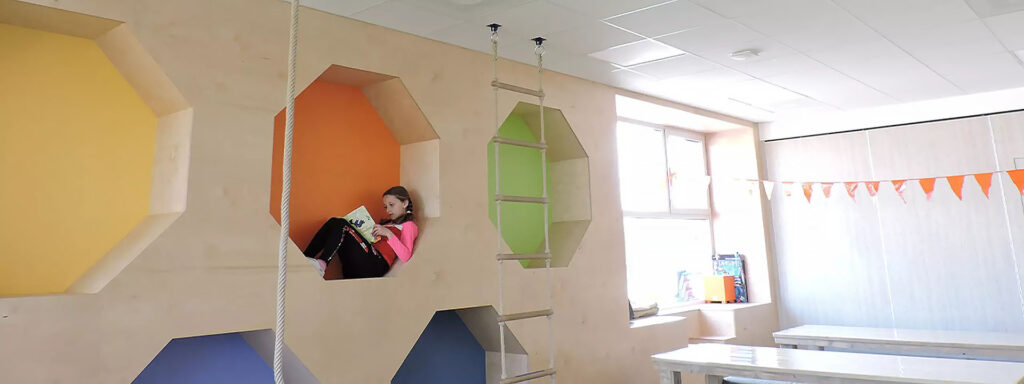
The Alblasserdam elementary school in the Netherlands demonstrates the effectiveness of these combined solutions. Faced with the constant chatter that causes fatigue and hinders concentration, the school has installed Isover and Gyproc insulation panels and Ecophon suspended ceilings to optimize acoustic comfort. This has resulted in noise reduction of up to 45 dB and an improvement in speech clarity of 4 to 8 dB. This same approach is being implemented in open-plan offices and communal areas, creating environments where acoustic performance is becoming a design criterion in its own right.
While technical solutions exist, their adoption faces several obstacles: the additional cost of purchasing some materials due to their innovative and recent nature, a design culture that prioritizes energy over acoustics, and the widely varying acoustic standards between countries, all hinder the harmonization of solutions on a global scale. For all that, there are increasingly encouraging signs: hospitals, schools, and offices are incorporating reverberation thresholds into their design, sustainable materials are becoming more competitively priced, and acoustic simulations are becoming widespread in the design process. The challenge now is to transform these innovations into generally accepted standards to make silence one of the fundamentals of comfort in our buildings.
Also Read:
Sustainability and comfort go hand in hand
Health and well-being: a challenge for sustainable construction