
 ›
Renovation
›
The Real-World Effects of Residential Energy Renovation
›
Renovation
›
The Real-World Effects of Residential Energy Renovation 
 8 min
8 min
Share

Écouter cet article
La version audio est fournie par Trinity Audio. Son activation dépose des cookies permettant de vous identifier de manière persistante. En savoir plus
In recent years, several studies have fueled debate over the return on investment of energy renovations, pointing to observed savings that fall short of the theoretical savings expected(1). Against this backdrop, ECOREBA, a research initiative led between 2022 and 2025 by the Climate Economics Chair at Paris Dauphine-PSL University (France)(2), was launched to provide a clearer picture of the real effects of energy renovation. The project combined two complementary approaches: an international meta-analysis and a statistical study of actual energy consumption in French homes. Here are its key findings.

Key Finding #1: Energy Renovations Do Deliver Savings
ECOREBA reaffirms the important role of energy renovation. Its international meta-analysis, based on 46 studies, shows that energy renovations do reduce household energy bills. Depending on the study, the savings observed range from a 10% to 11.6% reduction in energy costs for renovation projects costing between €3,100 and €3,970.
Even single-measure renovations(3) therefore generate measurable savings. While these savings are not dramatic, they are broadly proportional to the scale of the work undertaken.
Key Finding #2: In Energy-Inefficient Homes, Some Households Underheat Their Homes
Based on a sample of nearly 133,000 dwellings, the study found that in the least energy-efficient homes, actual energy consumption is often significantly lower (by as much as 49%) than the theoretical consumption estimated by the Energy Performance Certificate (EPC)(4). According to the researchers, this reflects a phenomenon known as the “prebound effect”.
In practical terms, while EPC calculations assume the same level of indoor comfort regardless of a building’s energy performance, many households living in energy-inefficient homes (properties rated G, F, and even E) reduce their heating use, leave some rooms unheated, or are forced to maintain indoor temperatures below the minimum acceptable comfort level in order to keep their energy bills affordable.
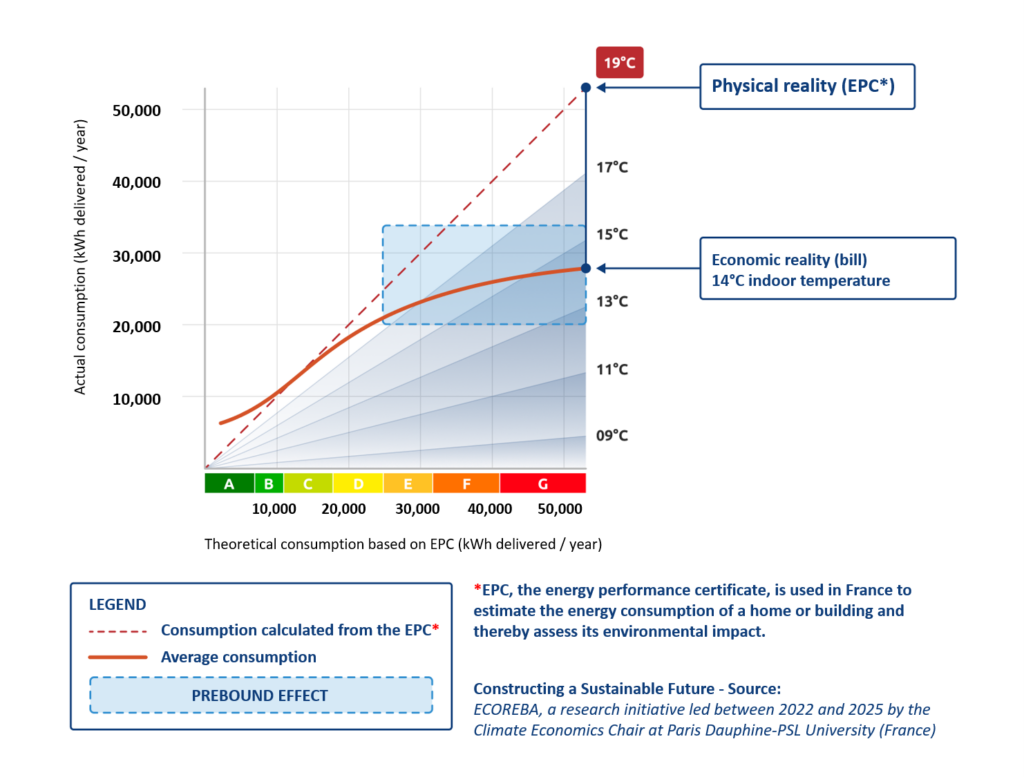
The study shows that this form of restricted energy use is widespread and closely linked to a home’s energy performance.
It also demonstrates that the phenomenon is more pronounced among lower-income households, which face greater budget constraints and must make difficult spending trade-offs. For homes with the same energy performance rating, the lowest-income households consume up to one-third less energy than higher-income households.
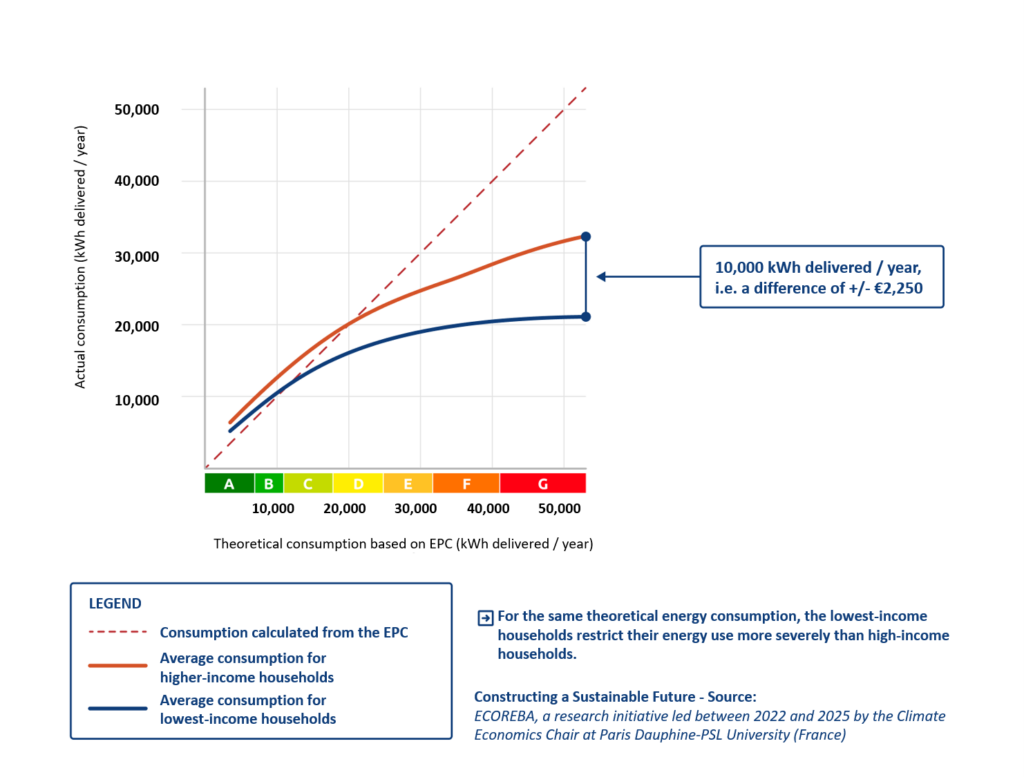
This “prebound effect” helps explain why some single-measure renovations may deliver lower-than-expected energy savings in practice. A significant share of the performance gains is first used to improve occupants’ living conditions and, for the most vulnerable households, to lift them out of situations of inadequate housing, underheating, and energy poverty.

What Are the Implications for Renovation Policies?
ECOREBA’s findings lead the researchers to recommend changes in the way energy renovation policies assess building performance and target public support:
- Assess the intrinsic energy performance of homes independently of occupant behavior. How? By measuring performance before and after renovation based on the building’s modeled energy demand (that is, the theoretical amount of energy required to provide standardized comfort conditions) rather than relying solely on observed post-renovation energy consumption. In the same spirit, ECOREBA also highlights that key parameters, such as the actual thermal performance of building envelope insulation, could be verified directly on site to improve the accuracy and reliability of the results.
- Take household income levels and energy poverty into account when targeting public support, since the effects of renovation vary depending on occupants’ economic circumstances. Energy rationing behaviors are particularly pronounced among lower-income households.
- Prioritize deep renovations(3) in homes rated E, F, and G, as they are better able to combine improved comfort with lasting reductions in energy consumption.
What ECOREBA Changes
ECOREBA reaffirms the central role of energy renovation and provides robust statistical evidence of its effects. Yes, energy renovations reduce both energy consumption and household energy bills. But they also serve a broader purpose: improving living conditions, tackling energy poverty, and making homes healthier, safer, and more comfortable.
The study also highlights the importance of continuing to scale up high-performance renovations capable of delivering improved comfort, lasting reductions in energy consumption, and sustained effectiveness over time. For the researchers, the challenge is therefore not to question the value of energy renovation, but rather to better understand its real-world impacts in order to better target public policies and prioritize the most effective renovation measures.
MethodologyThe ECOREBA research initiative, conducted between 2022 and 2025 by the Climate Economics Chair (Paris Dauphine-PSL University) with the support of CSTB, EDF, EFFY, and Saint-Gobain, combines two complementary approaches: an international meta-analysis of 46 studies on residential energy renovation and an analysis of nearly 133,000 French homes comparing actual energy consumption with modeled energy demand.
The study relies exclusively on publicly available data to ensure the transparency, robustness, and reproducibility of its findings. Researchers combined energy data, housing characteristics, climate variables, and socio-economic indicators, using an econometric methodology designed to distinguish the intrinsic energy performance of buildings from the actual behavior of occupants.
Notes :
(1) Including, in particular, the 2019 study by Blaise and Glachant and the 2025 INSEE-SDES study on thermal insulation.
(2) With the support of CSTB, EDF, EFFY, and Saint-Gobain.
(3) Energy renovation encompasses all measures aimed at improving comfort in a home while reducing energy consumption and CO₂ emissions:
- Single-measure renovations involve addressing one component at a time: insulating the attic or walls one year, replacing the heating system at a later stage, upgrading windows, and so on.
- Comprehensive (or deep) renovations follow a different approach. They address the dwelling as a whole by improving the thermal envelope, airtightness, ventilation, and heating systems. Ideally, they are carried out in a single phase of work, or, alternatively, through a limited number of successive phases based on a comprehensive renovation plan established upfront.
(4) “Theoretical energy consumption” refers to a standardized estimate of the energy required to provide a defined level of comfort in a home, regardless of how occupants actually use the building. This principle is used in many energy performance certificates across Europe, although calculation methods vary from one country to another. In the case of the French Energy Performance Certificate (EPC) used in the ECOREBA study, the 3CL-DPE methodology calculates the energy required to maintain a temperature of 19°C (66°F) throughout the entire dwelling during winter, as well as the energy used for domestic hot water and lighting over a full year.
You may also be interested in:
Green value in Europe: energy performance is a game-changer for the real-estate sector
Episode 2: Renovation in Sustainable Construction
“Change will require a systemic approach to modify policies and markets in a synchronized way.”
E… for Energy efficiency (Podcast)
“We don’t pull down unless it’s absolutely necessary”
“The energy transition also requires the development of a skilled workforce.”