

 ›
Politics and economics
›
Green value in Europe: energy performance is a game-changer for the real-estate sector
›
Politics and economics
›
Green value in Europe: energy performance is a game-changer for the real-estate sector 
 7 min
7 min
Share

Écouter cet article
La version audio est fournie par Trinity Audio. Son activation dépose des cookies permettant de vous identifier de manière persistante. En savoir plus
In just a few years, under the combined effect of sustained energy price increases, stricter regulations, and more stringent banking requirements, the energy rating of buildings has become a key economic indicator.
The movement is gradual, but deep rooted. It is not a passing fad for “green” buildings, nor is it just for show. Market data reveals a more fundamental reality: energy performance now directly influences prices, asset liquidity, and the perception of real-estate risk.
A clear correlation between energy rating and property value
The figures are unambiguous. In several European countries, the most energy-efficient homes sell for more than comparable mid-rated properties, while the drop in value of the least efficient buildings is gaining pace. Whether it’s a major renovation to upgrade a property to the highest energy rating, or a project designed from the outset to minimize consumption, energy-efficient buildings are becoming increasingly attractive.
For example, the price difference between homes with the best energy rating and those with the worst reached 31% in France and 33% in Belgium in 2024. The difference reached 23% in Italy and the Netherlands, according to the latest available data, and 18% in Spain. These figures are calculated based on comparable properties in terms of surface area, but also in terms of intrinsic qualities (presence of balconies, elevator, general level of comfort, etc.). So these price differences are purely down to energy performance.
23%That is the price gap in Italy and the Netherlands between homes with the highest energy performance rating and those with the lowest rating, all other characteristics being comparable.
Price differences that are increasing year after year
Studies comparing several years show that the differences in value are not stabilizing, but increasing. In other words, good energy performance does not create a one-off advantage; it is an asset that appreciates over time.
Between 2021 and 2024, the price difference between the most energy-efficient homes and those with the highest energy consumption increased in several European countries.
This trend does not depend on a specific regulatory context. In the Netherlands, UK, and Germany, as well as in Spain and Italy – all very different markets – the trend is the same: energy-efficient properties hold their value better, while poorly rated homes are losing value at a growing pace.
This acceleration in the trend is a game-changer. It is no longer just a question of whether a building is “worth a little more”, but whether there is a structural risk of it losing value.
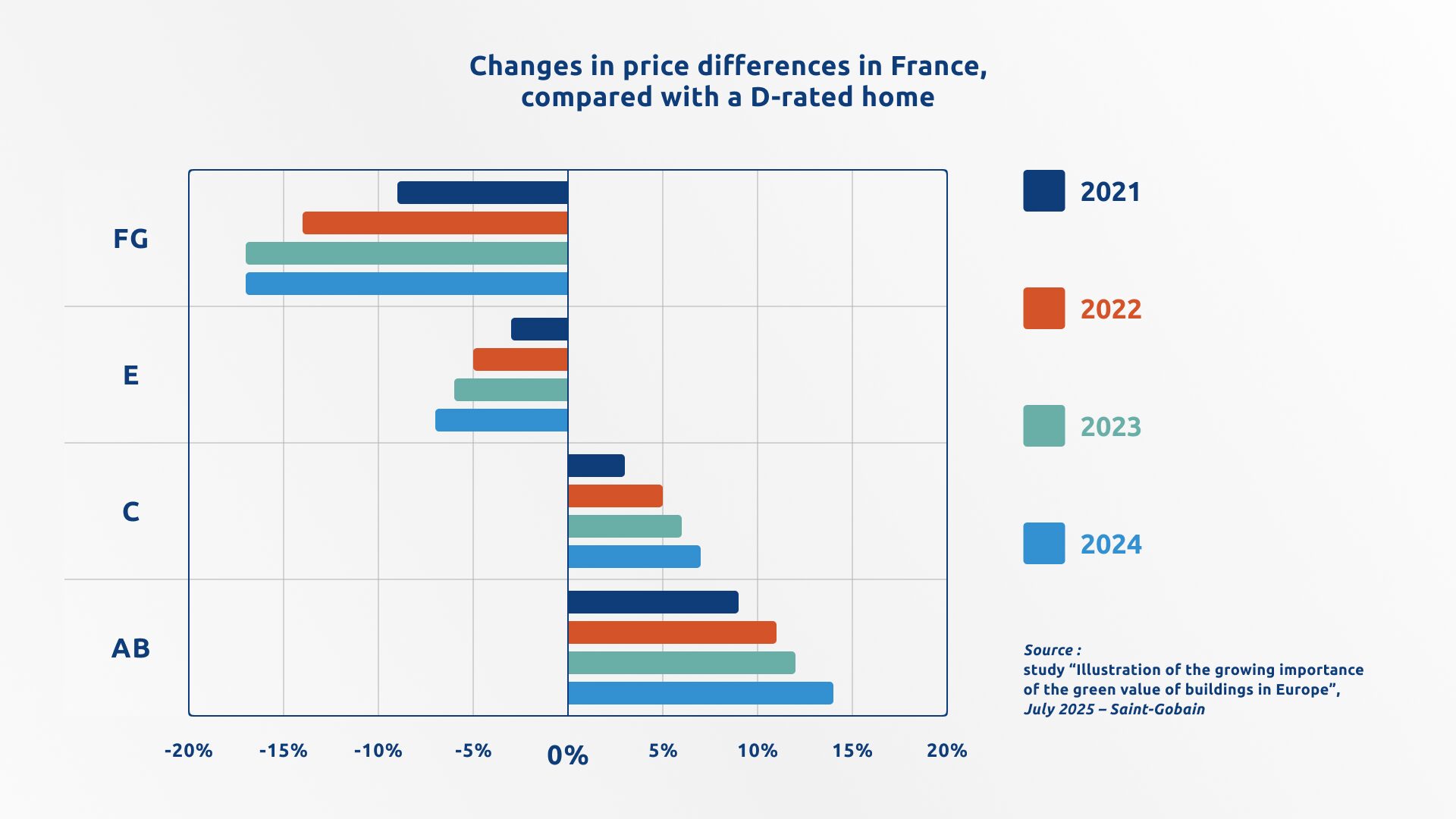
An example in France is shown in the diagram below: the price differences between the most energy-intensive and least energy-intensive homes, compared with a D-rated home, continued to widen between 2021 and 2024, even when correcting for the impact of other factors that influence price. The gap between the highest-rated and lowest-rated homes also widened by 10 points in Belgium and 6 points in Spain in just three years.
The domino effect: buying, financing, renting
This energy requalification of the building stock now has implications for three key decisions.
When buying, investors and individuals are increasingly making decisions based on the overall cost of the property, taking into account future energy bills and the work required to bring the home up to standard. Energy-efficient housing appears more predictable and thus more attractive.
On the financing side, banks and institutional investors are gradually incorporating energy performance into their risk assessment. While the specifics vary from country to country, the trend is clear: energy-intensive assets are perceived as being more exposed to future costs, regulatory constraints, and lower liquidity.
Lastly, when it comes to renting, the energy bill becomes a decisive factor in making a choice. Against a background of persistently high energy prices, a building’s ability to limit costs has a direct impact on its marketability, in both the residential and commercial sectors.
See also:
Figure Out video Episode 2: Renovation in sustainable construction
Europe as a testing ground
Here, Europe is acting as a testing ground. Where regulatory frameworks are clearest, the effects of green value are most evident.
In the Netherlands, the requirement for offices to have a minimum energy rating of C has profoundly restructured the tertiary market. The data shows that offices meeting this threshold are valued approximately 20% higher than buildings rated D to G. The regulation did not artificially create value; it made it visible and measurable.
In France, the gradual ban on renting out the most energy-intensive homes is having a similar effect: energy performance becomes a criterion for compliance, then a criterion for value. In the UK and Germany, each according to its own mechanisms, the same gradual polarization is observed.
What is the Energy Performance of Buildings Directive?
The Energy Performance of Buildings Directive (EPBD) is the EU’s main legislative instrument aimed at improving the energy performance of buildings across Europe. It was first introduced in 2002 to meet EU commitments under the Kyoto Protocol. Since then, it has undergone several revisions. The 2024 update sets a goal to decarbonize the building stock by 2050 and accelerate renovation efforts, especially for the most energy-intensive buildings.
What stakeholders hadn’t expected…
What the European data reveals is a change in the nature of energy performance, which has become a property criterion in its own right.
For home owners, it determines their ability to maintain the value of their asset. For investors, it directly influences the risk profile. For occupants, it weighs on running costs and home comfort. Green value, as it stands today in Europe, is thus neither a seal of approval nor a promise: it is the economic reflection of measurable performance. The wider the gap becomes, the more certain it is that energy issues have the power to create or destroy value in the European real estate market.
Source: The figures cited in this article are taken from the study “Illustration of the growing importance of the green value of buildings in Europe”, July 2025 – Saint-Gobain
Read also :
Rapid transition in the space of a few decades is possible.
Energy-efficiency best practices
What’s the purpose of energy renovation?
Four European Cities at the Cutting Edge of the Ecological Transition
The European Union already has a leadership role in sustainable construction