
AI for the greater good

Leiden (Netherlands). Researchers at Leiden University are undertaking collaborative research, exploring how artificial intelligence can unify and interpret data from across the Dutch energy system to create a smart grid (smart grids use digital technologies to optimize the management and distribution of energy and other urban resources).
 ›
Decarbonization
›
AI for the greater good
›
Decarbonization
›
AI for the greater good 
 6 min
6 min
Share

Écouter cet article
La version audio est fournie par Trinity Audio. Son activation dépose des cookies permettant de vous identifier de manière persistante. En savoir plus
From the initial sketch through to selective demolition, artificial intelligence is helping to transform the way buildings are designed, constructed, and managed. It does not replace professionals; it enhances their capabilities. This brings valuable benefits: drastically reducing a project’s carbon footprint, optimizing all resources, and enabling truly circular construction. How is it possible? Find out in 6 steps.

1 – Design: Simulate. Optimize. Decarbonize from the first sketch
Algorithms explore thousands of configurations in a matter of hours: solar orientation, natural ventilation, acoustics, structure. Recommendation systems go further.
By analyzing thousands of similar projects, they suggest optimal solutions by comparing cost, lead time, and risk of defects. The carbon impact of dozens of variants is compared even before the first stroke of the pencil. AI does not replace architects: it accelerates and enhances their ability to design more accurately, with greater energy savings, and more reversibly.
For its Toronto offices, Autodesk collected data on its teams’ working habits and then let generative AI explore 10,000 layout variations. There were six simultaneous criteria: proximity to colleagues, natural light, outdoor views, minimal distractions, interconnectivity, and preferred work styles. The result is an office floor that combines energy efficiency and occupant well-being, designed in a matter of days rather than weeks.

2 – Construction: a streamlined, safer, lower-carbon construction site
AI orchestrates every movement. It analyzes delivery flows, anticipates conflicts between trades, and adjusts schedules according to weather conditions.
Data from thousands of similar construction sites feeds into its predictions: it knows when to order, where to store, and how to optimize each rotation. Autonomous robots take over repetitive and onerous tasks, such as assembling modules, installing siding, and pouring slabs, with precision down to the nearest millimeter. Computer vision video cameras detect non-compliance before it becomes a costly defect. The result is on-time completion, enhanced safety, and a reduced carbon footprint from the construction phase onwards.
3 – Renovation: seeing the invisible to renovate the essential
3D scanning combined with AI maps every square inch of a building in a matter of hours with high precision. Algorithms detect what the eye cannot see: incipient cracks, structural deformations, hidden thermal bridges, invisible disorders. Predictive analytics targets areas at risk before they get worse. Renovation scenarios can be simulated instantly (energy impact, cost, carbon footprint) and compared. The result is ultra-accurate diagnostics, accelerated readings, and informed decisions. Renovation becomes an exact science in the service of performance.
Also read our articles on Renovation

4 – Operation: performance and comfort, day after day
The building lives with its occupants. Algorithms cross-reference current occupancy, weather conditions, and habits to adjust heating, ventilation, and air conditioning to within one degree. Each room receives the energy it needs, when it needs it. Maintenance becomes predictive: AI detects the warning signs (abnormal vibration, temperature fluctuations, unusual consumption, etc.). It schedules maintenance before a breakdown occurs, thus avoiding costly repairs and emergency shutdowns. The result is maximum comfort, minimum consumption, more durable equipment, and lower maintenance costs. The building becomes smart, combining energy savings with user comfort.
5 – End of life/selective dismantling: clean dismantling with extensive reuse of materials
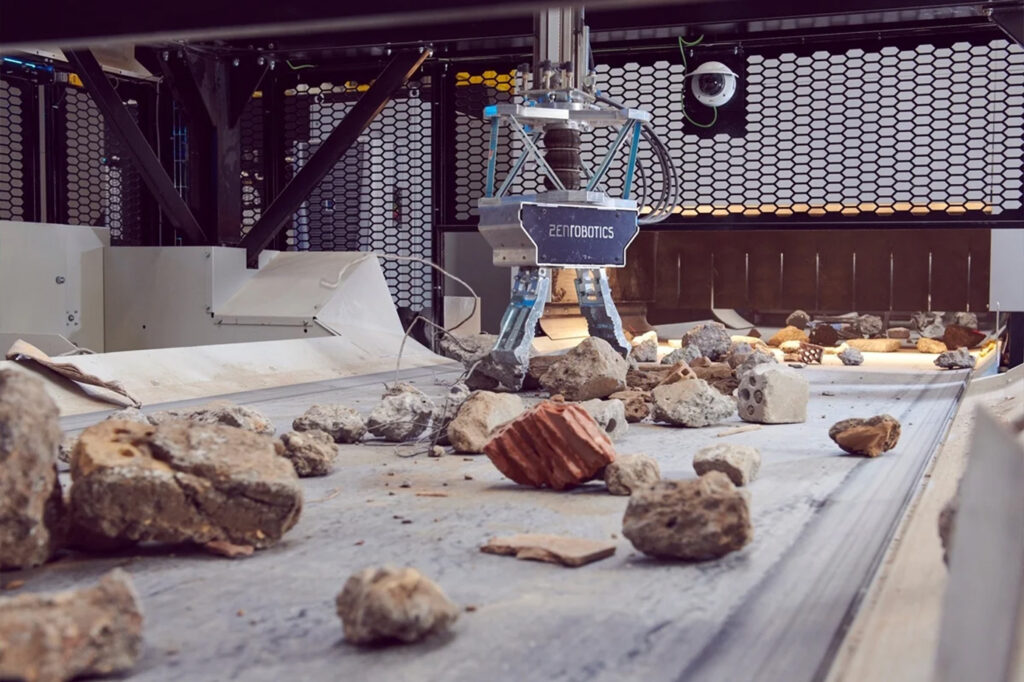
No more indiscriminate demolition. 3D scanning tools coupled with artificial intelligence scan the building, identify any reusable material (doors, windows, ceiling tiles, cladding, joinery, etc.) and assess its potential. The algorithms sort the material by category and quantify it. On site, compact demolition robots are guided by BIM (Building Information Modeling): operators can see in real time on their tablets what needs to be demolished and what needs to be preserved, thus avoiding pipes, cables, and components that need to be kept. The dismantling schedule is optimized to maximize recovery. Each item can find a second life on other construction sites via dedicated platforms or in other products through recycling. Yesterday’s waste becomes tomorrow’s resource.
6 – Building × city: buildings that talk to each other
In cities, AI coordinates buildings to create smart grids: shared energy production, shared storage, real-time management of consumption peaks. Algorithms analyze mobility flows, air quality, and heat islands, and automatically adjust public lighting and urban ventilation. Thousands of sensors communicate with each other to optimize electricity distribution, ease traffic flow, and manage waste collection. The building becomes a node in a smart network that communicates constantly with the city.
ConclusionArtificial intelligence is emerging as a key driver of sustainable construction performance. By connecting, analyzing, and optimizing data across the entire building life cycle, AI helps improve productivity, reduce waste, lower operating costs, enhance safety, and support informed decision-making. Combined with proven sustainable construction solutions, digital technologies enable buildings that are more efficient, resilient, and attractive to users and investors alike. As the built environment evolves, AI is becoming an essential tool for delivering high-performance, low-carbon, and future-ready construction.
Also read: It is essential to develop AI tools dedicated to construction professionals.